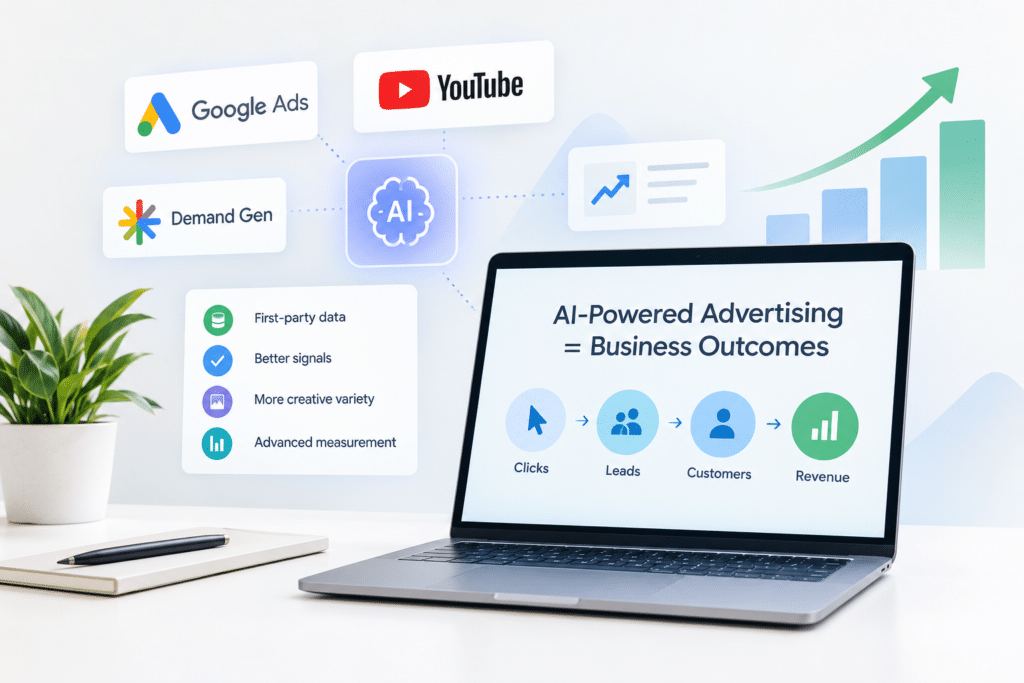
Google’s Rethink ROI event put a spotlight on a major shift happening across digital advertising: AI-powered advertising is increasingly focused on business outcomes, not just clicks, conversions, or other platform-level metrics.
As Google’s advertising systems become more capable of using AI to identify audiences, optimize campaigns, select creative, and make decisions across channels, the quality of the information businesses provide becomes increasingly important.
That means stronger first-party data, better conversion signals, more creative variety, and more sophisticated measurement are becoming important parts of an effective advertising strategy.
Here are five key takeaways from Google’s latest advertising updates and what they mean for businesses.
1. First-Party Data Is Becoming Part of Your Advertising Strategy
First-party data is information a business collects directly from its customers and prospects, such as customer information, website interactions, purchases, qualified leads, and sales outcomes.
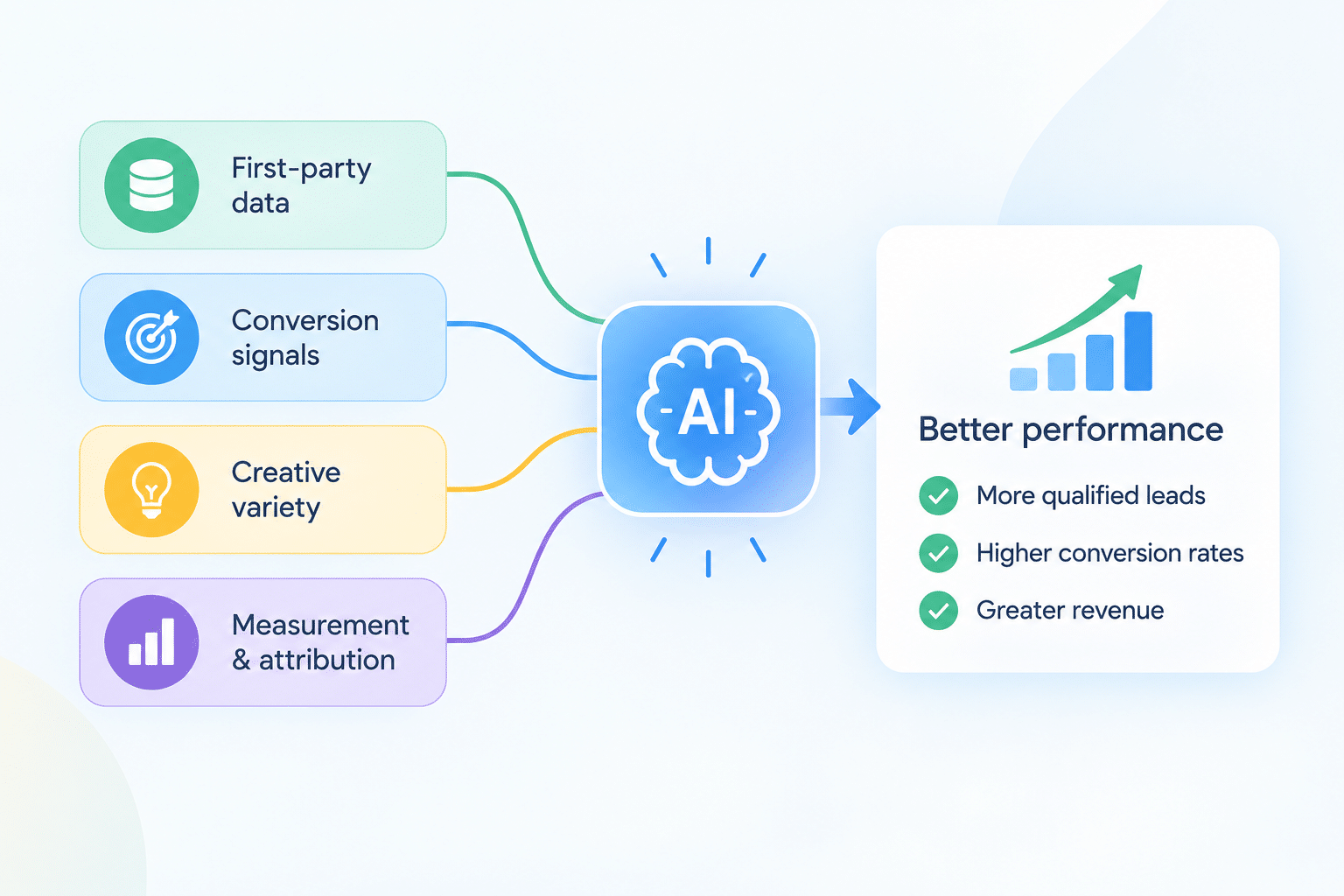
Google is putting increased emphasis on using this information to strengthen the signals available to its AI-powered advertising systems.
Recent updates to Google’s measurement and data tools include improvements involving Data Manager, enhanced conversions, offline data connections, and diagnostics. The goal is to help businesses provide Google with better information about what happens after someone interacts with an ad.
Why does that matter?
Because not every conversion has the same value.
A form submission might represent a highly qualified sales opportunity—or someone who is unlikely to ever become a customer. A phone call might turn into a sale—or it might be a general question that has nothing to do with the company’s services.
When advertising platforms can receive better information about what happens after the initial conversion, they have more meaningful signals to use when optimizing campaigns.
What this means for your business
Take a closer look at what your advertising platforms are being told counts as a successful conversion.
If your business tracks qualified leads, sales opportunities, customers, or revenue in a CRM, connecting that information with your advertising data can provide a much clearer picture of campaign performance.
Better data gives AI better information to work with.
2. Search Advertising Is Becoming Less Focused on Individual Searches
Search advertising has historically involved significant attention to individual keywords, search queries, bids, and campaign settings.
Google is increasingly using AI to handle more of those decisions.
One example is AI Max for Search, Google’s collection of AI-powered capabilities for Search campaigns. Google has continued expanding AI Max with tools that allow advertisers to test different budgets and ROI targets across multiple Search campaigns and use planning tools to evaluate potential campaign scenarios.
The broader shift is important: Google’s systems are increasingly designed to identify potential customers and opportunities based on the goals and signals provided by the advertiser.
That doesn’t mean strategy and control disappear.
It means the inputs become increasingly important.
Clear conversion goals, meaningful business data, relevant messaging, appropriate targeting, and strong creative give AI better information about what the campaign is actually trying to accomplish.
What this means for your business
Instead of evaluating Search campaigns only by individual keywords, clicks, or cost per conversion, look at whether the campaign is equipped to identify and pursue the opportunities that matter to your business.
For example:
Traffic → Leads → Qualified Opportunities → Customers → Revenue
The closer your advertising data gets to the bottom of that chain, the more useful it becomes for understanding performance.
3. YouTube Is Becoming More Connected to Performance
YouTube has traditionally been associated with awareness and brand building.
Google is increasingly connecting video advertising with measurable performance goals, including lead generation and customer acquisition.
One important part of this shift is Demand Gen.
Demand Gen campaigns allow advertisers to reach potential customers across Google’s visual surfaces, including YouTube and YouTube Shorts, as well as Discover, Gmail, and the Google Display Network.
Google has continued adding measurement and optimization capabilities to Demand Gen to help advertisers understand how these campaigns contribute to customer actions.
Google has also introduced Attributed Branded Searches, a reporting metric that can help advertisers understand branded search activity following exposure to eligible YouTube advertising.
This doesn’t mean that every branded search following an ad exposure was necessarily caused by that ad.
Instead, it provides another signal that can help businesses understand activity further along the customer journey.
The customer journey is becoming more connected
Someone might:
See a video → Become familiar with a company → Search for the brand → Visit the website → Return later → Submit a form
Looking only at the final conversion can make it difficult to understand all of the advertising activity that contributed to that journey.
Video can play a role earlier in the process while Search, remarketing, branded activity, and other channels may contribute later.
What this means for your business
Don’t evaluate YouTube or video advertising solely on views and clicks.
Consider how video fits into the larger path from:
Discovery → Consideration → Search → Conversion
The goal isn’t necessarily to make every channel responsible for the final conversion. It’s to understand how different advertising activities can work together to support business growth.
4. Creative Variety Gives AI More Options to Work With
Google’s YouTube Performance Four identifies four areas that can contribute to Demand Gen performance:
- Data Strength
- Conversion Volume
- AI Targeting
- Creative Variety
The creative component is particularly important as AI takes on more responsibility for determining which combinations of audiences, messages, formats, and placements perform best.
Google recommends providing a variety of creative assets, including different formats and aspect ratios such as horizontal, square, and vertical images and video.
Google has reported that advertisers adopting at least three of the four Performance Four practices saw, in its internal data, more than 40% more conversions and 30% higher conversion value. These are Google’s reported results and should not be treated as universal performance benchmarks.
The larger takeaway is that AI needs options.
One video gives an advertising system one message and one format to work with.
A collection of creative assets gives it more combinations to test and optimize.
What creative variety can look like
A strong creative library might include:
- Different messaging angles
- Multiple hooks
- Different video lengths
- Horizontal and vertical video
- Square and vertical images
- Different calls to action
- Customer-focused and product-focused messaging
- Creative designed for different stages of the buying journey
What this means for your business
Rather than creating one video or one ad and expecting it to work everywhere, think about building a collection of assets that gives campaigns more opportunities to find the right message and format for the right audience.
More creative variety gives AI more combinations to work with.
5. Measuring ROI Is Becoming About More Than the Last Click
One of the biggest themes in Google’s latest measurement updates is the need to understand advertising impact beyond the numbers reported by an individual advertising platform.
Google’s current measurement approach emphasizes three areas:
A strong data foundation. Multiple signals. Causal measurement.
These approaches are designed to help businesses understand the relationship between marketing activity and actual business outcomes.
Google continues to develop and promote tools such as Meridian, its open-source Marketing Mix Model, and GeoX, which can be used for causal geographic experiments.
These types of measurement approaches can help answer a different question from traditional attribution:
Instead of asking:
“Which campaign received credit for this conversion?”
Businesses can also ask:
“What impact did this advertising activity have on overall business growth?”
Those are not always the same question.
What this means for your business
Advertising platform reporting is valuable, but it shouldn’t necessarily be the only source used to evaluate marketing performance.
Depending on the business and available data, a broader measurement framework might include:
- Advertising conversions
- CRM data
- Qualified leads
- Sales opportunities
- New customers
- Revenue
- Brand search activity
- Experiment results
- Incrementality
- Overall business performance
The more closely advertising data can be connected to actual business outcomes, the clearer the picture of ROI becomes.
What Does Google’s Rethink ROI Mean for Businesses?
Across Search, YouTube, Demand Gen, and measurement, Google’s latest updates point toward a common direction:
Better data. Clearer goals. More signals. Better measurement.
AI-powered advertising systems can make increasingly sophisticated decisions about who to reach, when to reach them, what message to show, and how to allocate advertising resources.
But those systems still depend on the information and goals businesses provide.
That makes the foundation behind an advertising program increasingly important.
A campaign can generate thousands of clicks and still fail to produce meaningful business results.
A campaign can also generate fewer conversions while producing substantially more qualified opportunities and revenue.
The metric that matters most is ultimately the one that connects advertising activity to the business outcome you’re trying to achieve.
What Should Businesses Do Now?
The first step isn’t necessarily increasing your advertising budget.
Start by looking at the connection between your advertising platforms and your actual business results.
Ask:
Are your campaigns optimized for what is easiest to measure or for what actually matters to your business?
If your campaigns are optimized for form submissions but your business cares about qualified opportunities, there may be a gap.
If you’re optimizing for leads but your business cares about revenue, there may be a gap.
And if your advertising platforms don’t have access to the signals that distinguish valuable customers from everyone else, strengthening your data and measurement foundation may be more valuable than simply increasing your budget.
A More Complete View of Advertising ROI
The future of digital advertising isn’t simply about generating more clicks or more conversions.
It’s about creating a stronger connection between:
Advertising → Customer Actions → Qualified Opportunities → Customers → Revenue
As AI becomes more involved in advertising decisions, businesses have an opportunity to provide better signals, establish clearer goals, and measure performance against the outcomes that actually matter.
The future of ROI isn’t just about getting more from your advertising budget. It’s about giving your campaigns better information—and measuring whether that information leads to meaningful business results.