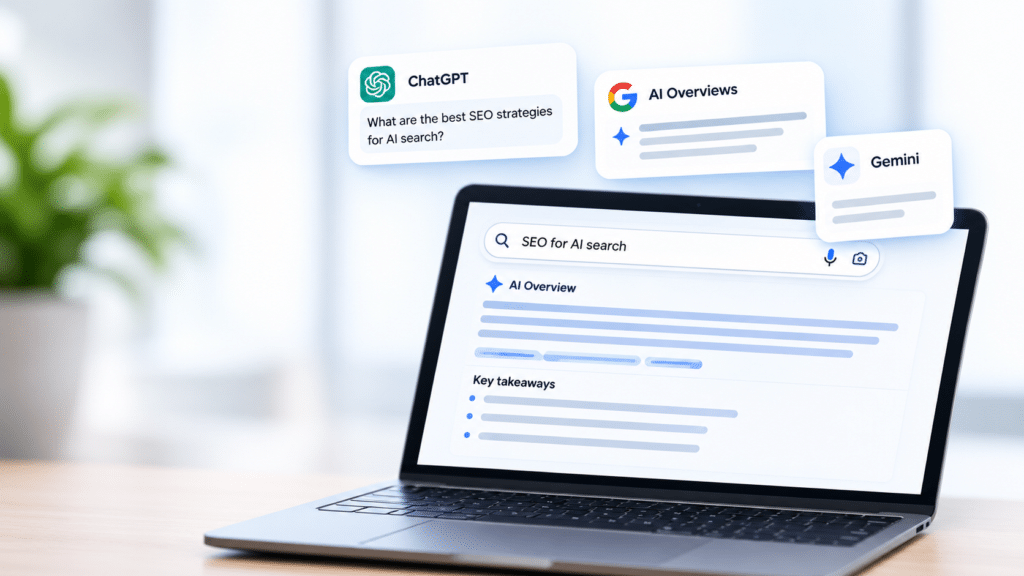
AI search is changing how people discover brands online, but the core principles of SEO still matter.
Despite the rise of AI Overviews, ChatGPT, and conversational search tools, businesses still improve visibility by creating helpful content, building authority, structuring information clearly, and maintaining strong technical SEO foundations.
At Pure Visibility, we’re seeing that the brands succeeding in AI search are usually the same brands already investing in:
- trustworthy content
- technical SEO
- schema markup
- local relevance
- clear website structure
- expert-driven insights
Here are 10 SEO fundamentals that still matter in AI-powered search experiences:
1. Is SEO Still Relevant in AI Search?
Yes! SEO is still highly relevant in AI search.
AI platforms like:
- Google AI Overviews
- OpenAI ChatGPT
- Gemini
- Perplexity
still rely on many traditional SEO signals to determine which sources are trustworthy and helpful.
That includes:
- content quality
- authority
- structured information
- backlinks
- technical SEO
- relevance
Search behavior is evolving faster than SEO fundamentals themselves.
2. Why Do AI Search Users Prefer Shorter Answers?
Users increasingly expect immediate answers.
Instead of reading long pages, many users now prefer:
- summaries
- direct responses
- FAQs
- conversational explanations
- scannable content
This shift is influencing both:
- AI Overviews
- featured snippets
- conversational AI tools
Businesses should still create in-depth content, but pages should also include:
- concise answers
- short paragraphs
- structured headings
- bullet lists
- quick summaries
AI systems favor content that is easy to extract and summarize.
3. What Is AEO (Answer Engine Optimization)?
AEO stands for Answer Engine Optimization.
AEO focuses on optimizing content to appear in:
- featured snippets
- “People Also Ask”
- AI-generated answers
- direct-answer search features
Google increasingly prioritizes content that quickly answers user questions.
How to improve AEO:
- answer questions directly
- use FAQ sections
- structure headings clearly
- include concise definitions
- add schema markup
- simplify complex explanations
AEO is less about ranking pages and more about becoming the answer itself.
4. What Is GEO (Generative Engine Optimization)?
GEO stands for Generative Engine Optimization.
GEO focuses on helping AI tools understand, trust, and reference your brand in conversational search experiences.
Unlike traditional SEO, GEO is not only about webpage rankings. AI systems synthesize information from multiple sources to generate responses.
GEO optimization strategies include:
- demonstrating expertise
- publishing trustworthy content
- maintaining accurate brand information
- implementing schema markup
- building authoritative citations
- structuring content clearly
At Pure Visibility, we view GEO as an evolution of SEO — not a replacement for it.
5. Why Does E-E-A-T Matter for AI Search?
E-E-A-T stands for:
- Experience
- Expertise
- Authoritativeness
- Trustworthiness
These signals help search engines and AI tools evaluate content quality.
Some marketers are now adding an additional “H” for Helpful content.
How to strengthen E-E-A-T:
- use real expert authors
- include author bios
- cite credible sources
- publish original insights
- demonstrate firsthand experience
- keep content accurate and updated
AI systems increasingly favor content written by identifiable experts rather than anonymous or low-quality AI-generated pages.
6. Why Is Schema Markup Important for AI Search?
Schema markup helps search engines and AI systems understand your website content.
Think of schema as “cliff notes” for search engines.
Schema can clarify:
- business information
- FAQs
- authors
- products
- reviews
- events
- locations
- article topics
Important schema types for AI visibility:
- FAQ schema
- Article schema
- Organization schema
- Author schema
- LocalBusiness schema
As AI search becomes more conversational, structured data becomes even more important.
7. How Can Local Businesses Improve AI Search Visibility?
Local SEO still plays a major role in AI visibility.
However, generic local content is becoming less effective.
Businesses need to create content that feels genuinely connected to their local community.
Strong local SEO signals include:
- geo-specific language
- local partnerships
- community involvement
- local backlinks
- event sponsorships
- neighborhood-specific content
A useful test:
Would local residents find this content genuinely helpful if it appeared in a community forum or subreddit?
At Pure Visibility, we’ve found that hyper-local relevance often strengthens both traditional SEO and AI visibility.
8. How Can Brands Prevent AI Hallucinations?
AI systems sometimes generate inaccurate information by combining multiple sources.
Brands can reduce misinformation risks by maintaining consistent information across the web.
Important steps include:
- claim all social profiles
- update local listings
- maintain accurate business information
- publish press releases
- monitor citations
- keep website content updated
Consistency matters across:
- your website
- Google Business Profile
- Yelp
- social platforms
- directories
AI tools often use third-party signals as validation sources.
9. Does Technical SEO Still Matter in AI Search?
Yes — technical SEO still matters significantly.
Even the best content struggles if search engines cannot efficiently crawl and understand your website.
Technical SEO helps search engines:
- discover content
- prioritize important pages
- understand site structure
- avoid wasting crawl budget
Important technical SEO elements include:
- internal linking
- robots.txt
- noindex tags
- crawl optimization
- site speed
- mobile usability
- schema implementation
At Pure Visibility, we often describe technical SEO like organizing a grocery store. If everything is difficult to find, both users and search engines become frustrated.
10. What Is Zero-Click Search — and Does It Matter?
Zero-click searches happen when users get answers directly from:
- AI Overviews
- featured snippets
- answer boxes
- conversational AI tools
The user receives information without clicking a website.
Examples of zero-click searches:
- “How tall is the Eiffel Tower?”
- “What is SEO?”
- “Weather today”
This shift means marketers should focus less on raw traffic and more on:
- conversions
- brand visibility
- purchase intent
- qualified leads
High-intent searches still drive meaningful business results.
For example:
- “What is Pilates?” may produce no clicks
- “Ann Arbor Pilates studio” still signals strong buying intent
Traffic alone is no longer the best measure of SEO success.
Key Takeaways for AI Search Optimization
Businesses do not need to abandon traditional SEO because of AI search.
The same core fundamentals still drive visibility:
- helpful content
- technical SEO
- authority
- trust
- structured information
- local relevance
- expert insights
The biggest difference is that content now needs to be:
- easier to summarize
- easier to extract
- easier for AI systems to interpret
Brands that adapt their content structure while maintaining strong SEO fundamentals will be best positioned for AI visibility.
Frequently Asked Questions About AI Search SEO
What is GEO in SEO?
GEO (Generative Engine Optimization) is the process of optimizing content so AI tools like ChatGPT and Google Gemini can understand, trust, and reference your brand in conversational search experiences.
What is AEO in SEO?
AEO (Answer Engine Optimization) focuses on helping content appear in featured snippets, AI Overviews, and direct-answer search results.
Is SEO changing because of AI?
Yes, user behavior is changing because of AI search experiences, but the core fundamentals of SEO still remain important.
Does schema markup help AI search?
Yes. Schema markup helps AI systems understand website content, authorship, business information, FAQs, and page structure more accurately.
What is zero-click search?
Zero-click search happens when users get answers directly in search results or AI-generated responses without clicking through to a website.
Can AI Overviews reduce website traffic?
Yes. AI Overviews can reduce clicks for informational searches, but businesses should focus on conversions and high-intent traffic rather than raw visit volume alone.
Final Thoughts
AI search is evolving quickly, but businesses do not need to reinvent their entire SEO strategy.
The companies that continue investing in:
- expertise
- trust
- technical SEO
- structured content
- local relevance
- helpful user experiences
will remain competitive across both traditional search and AI-powered discovery platforms.
At Pure Visibility, we help businesses build SEO strategies designed for both today’s search engines and tomorrow’s AI-driven search experiences.