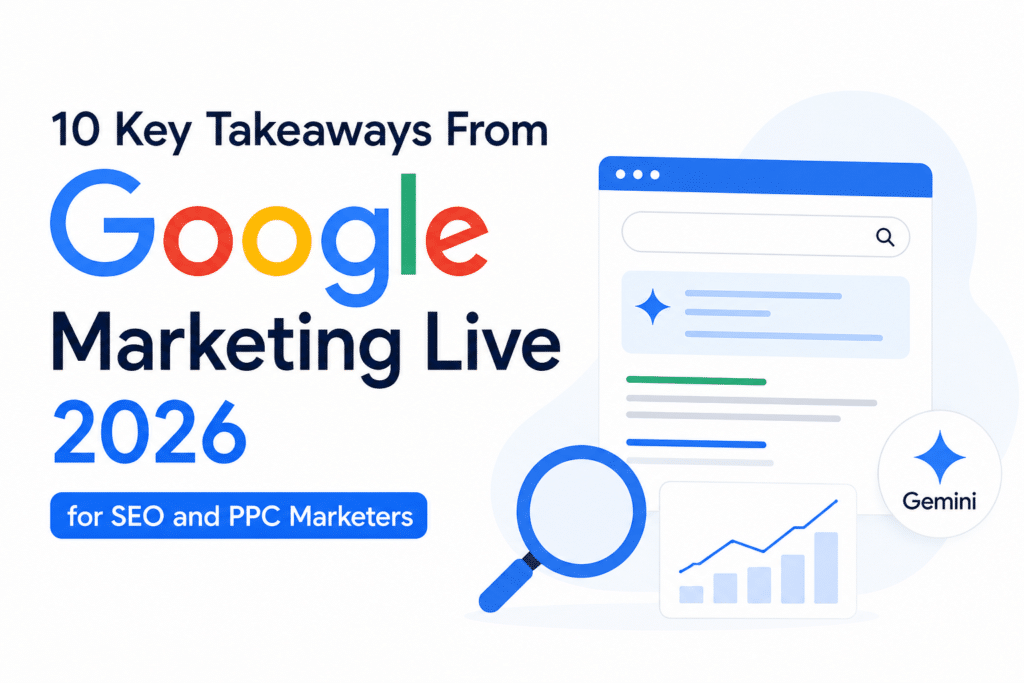
Google Marketing Live 2026 reinforced a clear direction for search and advertising: Google is evolving into an AI-first discovery engine powered by Gemini, conversational search, and automated advertising systems.
For marketers focused on SEO, PPC, and lead generation, this shift doesn’t replace traditional search — but it significantly changes how visibility, targeting, and conversions happen.
At Pure Visibility, we help businesses adapt to these shifts by aligning SEO, paid media, analytics, and content strategy with how Google is evolving.
Quick Summary: What Changed
Google shared updates across AI-powered Search, Gemini integrations, AI-generated ad experiences, and measurement tools during this year’s event. You can view Google’s official announcements from Google Marketing Live 2026.
- AI-powered Search experiences (including AI Overviews and AI Mode)
- Gemini integration across Google Ads
- Conversational and generative ad experiences
- Expanded automation in bidding and creative
- First-party data and measurement improvements
- AI-enhanced shopping and discovery journeys
The core shift: search is becoming more conversational, predictive, and AI-mediated.
1. AI Overviews Continue Reshaping Search Behavior
AI Overviews are increasingly shaping how users consume information directly on the search results page.
Rather than clicking multiple links, users often receive synthesized answers first, with supporting sources displayed below.
What This Means for Marketers
To remain visible in AI-driven search experiences, businesses should focus on:
- Clear, direct answers to user questions
- Strong topical authority
- Structured content with headings and FAQs
- Semantic relevance (not just keywords)
- High-quality educational content
Pure Visibility has already helped businesses improve visibility within AI-generated search experiences. See how we helped a client appear in AI Overviews in this AI SEO case study.
Businesses looking to improve visibility in conversational and AI-powered search can also explore our AI Search services
2. Conversational Search Is Now a Core Behavior Pattern
Google continues shifting toward natural language, conversational queries powered by Gemini.
Users are increasingly searching like:
- “What’s the best PPC strategy for lead generation?”
- “How do AI Overviews affect organic traffic?”
- “What’s the most effective way to generate B2B leads in Google Ads?”
What This Means for Marketers
Content strategy should evolve toward:
- Question-based keyword targeting
- Long-tail conversational queries
- Problem/solution content structures
- Intent-driven SEO instead of keyword matching
3. Google Ads Is Becoming More Automated and Predictive
Google announced continued expansion of AI-driven advertising systems, including:
- Gemini-assisted ad creation
- AI-generated creative recommendations
- Smarter Performance Max optimization
- Predictive audience targeting
- Enhanced bidding automation
What This Means for Marketers
Automation is increasing, but strategy remains essential.
Marketers still need to define:
- Conversion quality standards
- Audience segmentation strategy
- Creative messaging direction
- Budget efficiency goals
- Lead quality measurement
See how Pure Visibility used PPC to improve lead-generation performance in this PPC lead-generation case study.
Businesses can also learn more about our PPC management services.
4. AI Mode Ads and Conversational Ad Experiences Are Emerging
Google announced several new conversational and AI-powered advertising experiences integrated into AI-driven Search journeys, including AI Mode ads and conversational discovery formats.
These ad formats are designed to appear more naturally within conversational search experiences rather than traditional keyword-only placements.
For additional details, marketers can review Google’s official Google Marketing Live announcements and the Google Ads announcements hub.
What This Means for Marketers
Businesses may need to rethink:
- Ad messaging for conversational contexts
- Intent-based targeting vs keyword targeting
- Creative variation testing
- Funnel positioning within AI-driven discovery
This represents a structural shift in how paid search visibility is delivered.
5. First-Party Data Is Becoming a Competitive Advantage
Google also emphasized measurement, attribution, and first-party data strategies throughout the event.
Businesses with stronger data infrastructure may be better positioned to take advantage of evolving AI-powered advertising and analytics capabilities.
What This Means for Marketers
Businesses should prioritize:
- CRM integration
- Enhanced conversions
- Offline conversion tracking
- Customer Match audiences
- Accurate lead attribution systems
Companies with stronger data foundations are better positioned to optimize performance across Google Ads and organic channels.
6. Content Quality and Authority Matter More Than Volume
Google’s systems increasingly prioritize helpful, reliable, and well-structured content.
Low-value or repetitive content is less likely to perform well in AI-driven search environments.
What This Means for Marketers
Focus on:
- Expert-written content
- Original insights and analysis
- Clear explanations of complex topics
- Educational resources that answer real questions
- Strong internal linking and topic clusters
7. Technical SEO Remains Foundational
Even in an AI-driven search ecosystem, technical SEO remains essential for discoverability and indexing.
What This Means for Marketers
Businesses should ensure:
- Proper schema markup
- Fast page load speed
- Clean site architecture
- Mobile optimization
- Crawlable internal linking structures
- Accurate indexing signals
AI systems still rely on structured, accessible websites.
8. SEO and PPC Are Becoming More Connected
Google’s ecosystem continues blending organic and paid visibility signals across the same search experiences.
What This Means for Marketers
Integrated strategies can improve:
- Visibility across AI and traditional search
- Conversion rates
- Budget efficiency
- Audience targeting accuracy
- Brand consistency
At Pure Visibility, we specialize in aligning SEO and PPC to improve full-funnel performance.
9. Shopping and Discovery Are Becoming AI-Mediated
Google is expanding AI-powered shopping and discovery experiences that surface products earlier in the research process.
These systems summarize options, compare features, and guide users before they click into individual sites.
What This Means for Marketers
Brands should focus on:
- Strong product/service clarity
- Structured product data
- Trust signals and reviews
- Clear value propositions
- Content that supports early-stage research
10. AI Search Optimization Is Becoming an Emerging Discipline
Marketers are increasingly adapting SEO strategies for AI-generated search experiences.
While not an official Google term, this emerging discipline focuses on improving visibility within AI-driven summaries and conversational results.
What This Means for Marketers
To stay competitive, businesses should:
- Build topical authority
- Answer questions directly and clearly
- Strengthen semantic relevance
- Use structured data consistently
- Develop deep content clusters around core services
Google Marketing Live 2026 Action Checklist
Businesses should:
- Audit SEO content for clarity and structure
- Add FAQ sections to high-value pages
- Strengthen schema markup
- Improve first-party data tracking
- Optimize for conversational search queries
- Align SEO and PPC strategy
- Build topic authority instead of keyword silos
- Improve internal linking between related content
- Focus on high-quality educational content
Frequently Asked Questions
What was announced at Google Marketing Live 2026?
Google introduced updates across AI-powered search, Gemini integration, conversational ad formats, AI Mode experiences, automation improvements, and enhanced measurement tools.
How are AI Overviews changing SEO?
AI Overviews are changing how users consume information by providing summarized answers directly in search results, making structured and authoritative content more important.
Is SEO still relevant in an AI-driven search environment?
Yes. SEO is becoming more important because AI systems rely on high-quality, structured content to generate answers and recommendations.
How should PPC strategies evolve?
PPC strategies should combine automation with human oversight, focusing on conversion quality, audience intent, creative testing, and first-party data integration.
Final Thoughts
Google Marketing Live 2026 signals a clear evolution toward AI-first search and advertising.
However, success still depends on fundamentals:
- Strong content strategy
- Technical SEO health
- Data quality
- Strategic PPC management
- Clear understanding of user intent
Businesses that adapt early to AI-powered search behavior may be better positioned to capture future demand across both organic and paid search experiences.
If your organization is preparing for the shift toward conversational search, AI Overviews, and AI-powered advertising, explore Pure Visibility’s AI Search services or contact our team to build a strategy focused on qualified traffic and lead generation.